

The 2026 summer season stands out as one of the most severe periods for wildfires in Spain’s recent history. Against an unrelenting backdrop of climate change and global warming, the steady rise in temperatures and the combination of extreme weather conditions — marked by prolonged heatwaves and extraordinarily low relative humidity — have triggered high-intensity fires across several regions of the country.
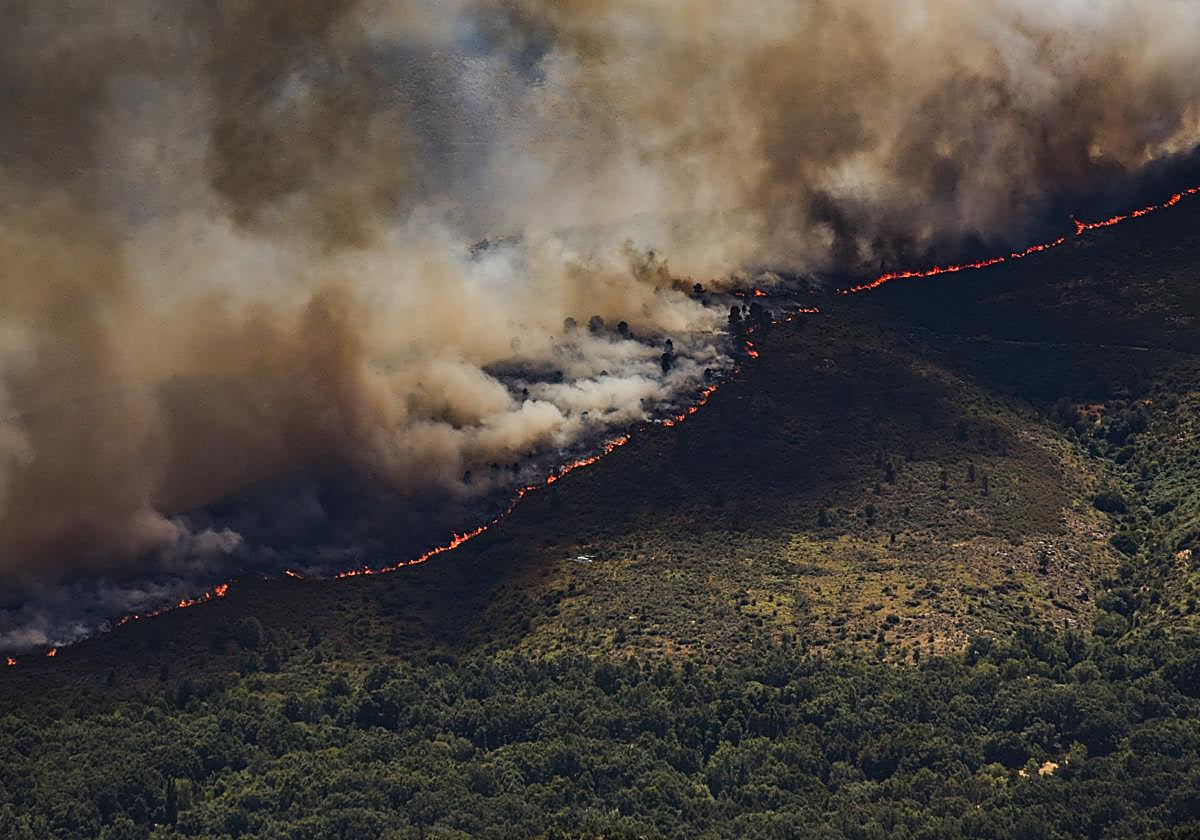
This article brings together the official data on the area burned, civil protection logistics, the impact of the fires on biodiversity and agricultural infrastructure, the key role that traditional land uses such as extensive livestock farming play in wildfire prevention, and a detailed analysis of the physiopathological effects of combustion products on livestock and local wildlife.
1. Current situation in Spain 2026: sector-by-sector impact
According to official tracking reports from the Ministry for Ecological Transition and the Demographic Challenge (MITECO) and Copernicus’ European Forest Fire Information System (EFFIS), Spain had recorded a cumulative burned area of 173,651.46 hectares by 28-29 July 2026. This figure is almost six times higher than the same period in 2025 and places the current fires at historic highs in terms of the size of each major wildfire.
The State Meteorological Agency (AEMET) and the Directorate-General for Civil Protection and Emergencies are maintaining extreme-heat warnings in 13 autonomous communities, with highs exceeding 42 °C in southern Spain.
AEMET’s Wildfire Risk Index (IPIF) places almost the entire country at high wildfire risk, as relative humidity below 15% and dry continental gusts increase fire risk and the speed at which a fire can spread and burn large stretches of scrubland and forest mass within hours.
The Ministry of the Interior, for its part, keeps the National Interest Emergency declaration active (Level 3 of the National Civil Protection Plan) in the Community of Madrid and the provinces of Ávila and Toledo, where the large-scale mobilisation of resources and firefighting efforts has been a top priority.

- Evacuations and lockdowns: Emergency coordination centres (ASEM 112) ordered the preventive evacuation of residents and stepped up action in wildland-urban interface areas across more than a dozen municipalities in the Sierra Oeste region of Madrid and the Alberche valley in Ávila (including Cadalso de los Vidrios, Cenicientos, Pelayos de la Presa, San Martín de Valdeiglesias and Rozas de Puerto Real), reinforcing neighbourhood self-protection plans.
- Transport infrastructure: The Regional Transport Consortium mobilised more than 80 buses for urgent evacuation to temporary shelters, with 13 secondary roads registering full or partial closures.
Causes of major wildfires: human origin and negligence
According to historical analyses by MITECO, most wildfires in Spain are of human origin, whether through negligence — such as poorly controlled agricultural or stubble burning, cigarette butts, or forestry work with machinery — or, to a lesser extent, through natural causes such as lightning strikes. Misinformation on social media about the real origin of each fire also adds difficulty to crisis management and official communication. Identifying and prosecuting this negligence is, together with preventive forest management, one of the central pillars of the fight against major wildfires.
2. Impact on wetlands and farming and livestock operations
Impact on wetlands and protected areas
Reports from MITECO and the Spanish National Research Council (CSIC), as well as analyses from bodies such as CREAF (Centre for Ecological Research and Forestry Applications), highlight that the fires have reached numerous Natura 2000 sites (SCIs and SPAs), causing habitat destruction and severely altering the natural habitat of many species and of wildlife in general, depriving wild fauna and biodiversity of their usual sources of food and shelter.
The destruction of vegetation cover on slopes adjacent to reservoirs and wetlands leaves the soil unprotected against erosion, which in turn accelerates erosion of river basins and causes water contamination. In addition, ash (pyrotoxins) rich in phosphorus, nitrogen and heavy metals washed into the water affects the aquatic ecosystem services of the burned area, causing anoxia and rendering these points unusable as watering holes.
Direct damage to farms
Technical assessments by the Valencian Association of Farmers (AVA-ASAJA) show substantial direct effects of the fires on productive infrastructure and farming activity:
- Woody crops: Destruction of citrus fields (oranges and mandarins), avocados, loquats, olives, almonds and vineyards.

- Infrastructure: Burning of farm buildings, tool sheds and irrigation networks.
- Usage restrictions: The Ministry of the Interior temporarily banned farm work with heavy machinery during the highest-risk hours, to prevent incidents caused by human activity or improper use of fire in rural areas.
Impact on livestock farming: evacuations, logistics and losses
Farmers and livestock producers have faced severe operational losses:
- Evacuation of farms and intensive facilities: In Castellón and central Spain, the proximity of a major fire forced the emergency evacuation of livestock farms to biosecure enclosures.

- Destruction of fencing and pastureland: In the extensive farming sector, the loss of fencing led to the uncontrolled scattering of herds, while the burning of pastures wiped out the basic summer feed supply.
- Livestock supply effort: ASEM 112 coordinated the distribution of more than 330,000 kg of forage and concentrated feed to sustain animals affected and hemmed in by the burned perimeter.
3. Smoke and air quality for livestock
Smoke generated by the breakdown of materials under intense heat without oxygen degrades large molecules and creates three new products: gas, liquid and a solid such as char. This process, called pyrolysis, releases highly toxic pollutants that harm environmental health:
- Particulate matter (PM10 and PM2.5): Fine particles capable of deep alveolar penetration.
- Toxic combustion gases: Carbon monoxide (CO), carbon dioxide (CO2), nitrogen oxides (NOx) and sulphur dioxide (SO2).
- Volatile compounds and PAHs: Highly toxic polycyclic aromatic hydrocarbons.
Sustained inhalation of gases and particles triggers severe clinical conditions:
- Alveolar deposition and inflammation: PM2.5 particles reach deep lung tissue, causing alveolitis, tracheobronchial oedema and reduced pulmonary surfactant.
- Tissue hypoxia from carboxyhemoglobin: Carbon monoxide (CO) binds to bovine haemoglobin, forming carboxyhemoglobin (COHb). This reaction blocks effective oxygen transport, leading to tissue hypoxia, lethargy, tachypnoea and cardiovascular collapse.
- Immunosuppression and secondary infections: Thermal tissue damage paralyses the response of alveolar macrophages, predisposing livestock to opportunistic secondary bacterial infections (Mannheimia haemolytica).
- Production and reproductive disorders: Respiratory difficulty reduces voluntary feed intake, causing sharp drops in milk production and increasing the risk of abortion in pregnant females.
4. Extensive livestock farming for comprehensive wildfire prevention
Forestry engineers and technicians, backed by studies from CSIC and MITECO, point out that structural causes such as the gradual abandonment of rural areas have favoured the continuous build-up of scrubland, dry vegetation and highly flammable biomass in the mountains. This scenario creates optimal conditions for the emergence of extreme, “sixth-generation” wildfires that produce uncontrollable fires.
In response to this problem, the revival of pastoral grazing management is emerging as one of the best solutions for preventing and fighting these disasters. Continuous browsing by goats and sheep removes tender shrub layers, preventing surface fire from climbing into the tree canopy and stopping a “fuel ladder” from forming. In addition, by reducing biomass density per square metre, grazing directly lowers the fire’s linear intensity, making it easier for firefighting crews to contain it.

Maintaining green infrastructure through planned grazing in firebreak areas paves the way towards a more efficient, sustainable forest management model that helps protect forests. The presence of livestock herds breaks up the continuity of scrubland (creating a mosaic structure), producing fire-resilient landscapes where the spread rate slows significantly. Beyond clearing safety strips, extensive livestock farming also helps preserve the landscape, disperses seeds and strengthens territorial resilience, thereby supporting biodiversity and ecosystem services.
Under the guidelines of the State Secretariat for the Environment and the Demographic Challenge area, greater use of Payment for Environmental Services (PES) schemes and territorial governance instruments is being promoted. These measures reward shepherds for their environmental work, consolidating a sustainable land-management model in the fight against wildfires.
To ease the economic damage suffered by farming and livestock producers, the Ministry of Agriculture, Fisheries and Food (MAPA) has approved extraordinary direct aid of up to €16,000 for policyholders with valid insurance. Agroseguro is also deploying its own loss-assessment teams to speed up compensation for losses of animals, crops and destroyed facilities. Reports from environmental organisations such as Greenpeace Spain further stress the urgency of allocating greater permanent preventive funding, rather than concentrating most public investment solely on firefighting efforts.
5. Conclusion
The ecological and environmental crisis recorded during the 2026 summer season shows that protecting our natural heritage and ensuring the sustainability of the primary sector are closely interconnected goals. Meeting the challenge of major wildfires requires going beyond immediate emergency response to implement a comprehensive plan based on structural prevention, ecosystem recovery in the post-fire phase, and the consolidation of traditional practices such as preventive grazing, in order to build more resilient farming and forest landscapes.

6. Frequently asked questions
1. How long will it take burned forest areas to achieve a functional ecological recovery after a high-intensity fire?
According to studies published by CSIC and MITECO, the regenerative capacity of Mediterranean vegetation allows the initial sprouting of grass and scrub within 2 to 5 years after a fire. However, the complete restoration of the tree canopy and complex ecosystems in the burned area can take between 20 and 50 years. In soils affected by a major wildfire (GIF) with severe soil degradation, full functional recovery may require more than a century of active restoration.

2. How does the deposition of pyrotoxins after wildfires cause lasting changes in the physicochemical quality of groundwater resources?
Technical reports from the Geological and Mining Institute of Spain (IGME-CSIC) and MITECO’s water conservation guidelines indicate that ash dissolution after a fire drastically increases the turbidity and conductivity of aquifers. The infiltration of heavy metals and hydrocarbons alters the water’s pH and reduces dissolved oxygen levels, rendering rural groundwater sources unfit for human consumption or direct livestock watering without prior advanced filtration treatment.
3. What biosecurity protocols and precautions should be adopted when wildlife fleeing the flames moves into farming or peri-urban areas?
Recommendations from MAPA and Wildlife Recovery Centres indicate that any direct approach to disoriented wild animals on the move should be avoided, to prevent stress or defensive attacks. Livestock farms are also advised to reinforce perimeter fencing to avoid direct contact with native wildlife, thereby preventing cross-transmission of pathogens (such as African swine fever or bovine tuberculosis) and protecting the welfare of livestock herds.
4. How do animals react to and survive a wildfire?
As flames approach, wildlife triggers escape mechanisms toward already-burned areas, water courses or open spaces, guided by their perception of heat and smoke. Animals with lower mobility — young, burrowing species or slow-moving ones — are the most vulnerable, while birds and large mammals are usually able to move away in time toward unaffected neighbouring habitats. This response capacity is compromised when a fire spreads at a very high rate, as has happened in several of the major wildfires of the 2026 season.
5. How does wildlife recover after a wildfire?
Animals begin recolonising burned land as soon as vegetation resprouts: the first to return are usually insects and small vertebrates, followed by herbivores and, gradually, by large predators such as the Iberian wolf in areas where it is present. In the most severe cases, forest management plans may include species reintroduction or habitat restoration measures to speed up ecosystem recovery, always under the technical coordination of MITECO and the relevant regional authorities.


 Ambiotec Solutions