

Heat Stress
Heat stress in swine is a physiological disruption that occurs when the ambient
temperature and relative humidity exceed the optimal range or "thermoneutral zone" for
these animals, which is between 16°C and 22°C for adults. When the ambient
temperature exceeds this range, the pig faces difficulties in regulating its body
temperature due to its anatomical and physiological limitations: few functional sweat
glands and a thick layer of subcutaneous fat that makes it difficult to dissipate heat.
Under normal conditions, thermoregulation mechanisms include heat transfer to the
skin (vasodilation), increased respiratory rate (panting) to promote water evaporation
through the airways, reduced physical activity and food consumption, and seeking cool
or moist areas.
However, as the ambient temperature and/or humidity increase, these mechanisms
become insufficient to maintain internal thermal balance. The excess heat accumulated
cannot be effectively eliminated, and an imbalance occurs between body heat
production (heat generated by metabolism and activity) and heat loss to the
environment, leading to an increase in core body temperature. If this state persists, the
animal enters a state of stress, characterized by symptoms such as intense panting,
lethargy, skin redness, decreased appetite, behavioral changes, and even more severe
disorders such as incoordination, collapse, or, in extreme cases, death.
Heat stress in swine not only affects their welfare but also generates negative
consequences at the productive level (lower weight gain, lower fertility and viability of
litters, poorer carcass quality), immune and health level (increased susceptibility to
diseases). Therefore, environmental management and adaptation of facilities are
essential to prevent and reduce the impact of this condition on pig farms.
Thermoregulation Mechanisms
1. Increased Respiratory Rate (Panting)
Panting is the main physiological resource used by pigs to dissipate heat. By
increasing the respiratory rate, pigs cause greater water evaporation from the mucous
surfaces of the upper airways, mainly at the level of the pharynx and trachea. This
mechanism allows a part of the pigs' body heat to be released into the environment
thanks to the evaporation process, which is an endothermic phenomenon (absorbs
thermal energy). During heat episodes, the respiratory rate can multiply several times
compared to the usual values, reaching in extreme cases more than 100 breaths per
minute.
However, panting has important limitations since the ability to evaporate water depends
heavily on environmental humidity: when it is high, the efficiency of the process
decreases drastically. Prolonged panting can cause respiratory alkalosis (by eliminating
too much CO₂) and quickly dehydrate the animal, worsening the situation. In addition,
it is a mechanism that involves a large additional energy expenditure.
2. Reduction of Physical Activity and Food Consumption
food intake. By moving less, pigs limit the heat generation derived from muscle
contraction and other metabolic processes associated with exercise. Similarly, by
reducing the amount of food ingested, the "heat of fermentation" produced during digestion decreases, especially relevant with diets rich in fiber or crude protein, since digestion and metabolism generate additional heat as a byproduct.
This strategy, although effective in minimizing endogenous heat production, carries
risks such as lower energy and essential nutrient consumption, affecting growth, pork
milk production, or reproductive rate depending on the production phase. If the
reduction in consumption is prolonged, productive recovery can be slow even when
temperatures decrease.
3. Seeking Cool or Moist Areas
It is common to observe them seeking areas of the pen in the shade, near cool walls,
downwind from air currents, or wallowing in mud or puddles of water if available. Direct
contact with colder surfaces facilitates heat loss from their own body by conduction
(from the body to the ground or to water/mud).
In the case of mud or water, in addition to conduction, evaporation is added: the water
that remains on the skin and evaporates extracts body heat, helping to lower the
animal's core temperature. This natural behavior has been fundamental for the survival of pigs in the wild, but in intensive systems where these options are not offered, the effectiveness of this mechanism is greatly reduced.
4. Peripheral Vasodilation
At the physiological level, another key response is the vasodilation of cutaneous blood
vessels. During heat situations, the autonomic nervous system activates mechanisms
by which the blood vessels of the skin dilate, facilitating a greater blood flow to the
body surface. As a result, the heat transported by the blood from the internal organs is
transferred more efficiently to the skin, and from there to the environment by
convection and radiation.
This explains the visible redness in the skin and ears of pigs subjected to intense heat:
it is fluid blood in the superficial capillary beds. However, if the ambient temperature
gets too close to the body temperature, the heat transfer becomes inefficient, and this
mechanism is no longer sufficient by itself to prevent overheating.
Key Limitations of Mechanisms in Swine
The porcine species stands out, unlike other species, for its limited sweating capacity.
The sweat glands in these animals are very poorly functional, and their skin is thick,
which practically cancels the classic sweating mechanism that animals such as bovines
or equines do possess. In addition, breeds selected for production often have
considerable subcutaneous fat layers, which further limits heat transfer to the body
surface.
For these reasons, panting and seeking moist/cool contact become the priority, albeit
inefficient, resources for heat dissipation, especially in unfavorable environmental
conditions such as high temperatures or high humidity.
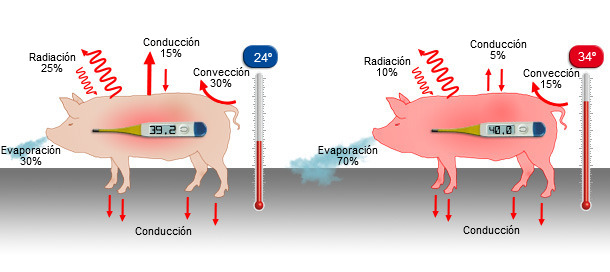
Thus, collapse occurs when the ambient temperature (and/or relative humidity)
exceeds the pig`s ability to dissipate excess heat through the aforementioned
mechanisms (panting, vasodilation, etc.). The thermoneutral zone for pigs varies
according to age and weight, but in adults it is usually between 16 °C and 22 °C. When
the ambient temperature exceeds 26–28 °C, the first effects of heat stress may appear,
and from 32–34 °C (especially with high humidity), the situation becomes critical and
the risk of collapse increases. The risk of collapse is even greater in heavy animals,
pregnant or lactating sows, and animals with little ability to move to cool areas.
Initial and Progressive Signs of Heat Stress
1. Early Changes (before collapse):
Increased respiratory rate (evident panting), decreased feed and water consumption,
restlessness, prostration or seeking cool, moist or more ventilated areas, isolation from
other animals and reduced activity, moist skin as a result of panting, possible excessive
salivation and/or reddening of the skin and ears due to peripheral vasodilation.
2. Signs of Worsening Due to Heat Stress:
Rapid and shallow breathing (sometimes >100 breaths/minute), lethargy or
exaggerated weakness, muscle tremors or incoordination of movements, tendency to
lie laterally and stretch the limbs (to increase the heat dissipation surface) and/or
increased body temperature (often >40 °C)
3. Collapse and Systemic Failure:
The effects of high and persistent heat stress over time result in prostrate animals,
unable to get up, convulsions or disorientation, cyanosis of the mucous membranes
(sign of hypoxia), weak or irregular pulse, difficulty breathing and/or sudden death due
to multiorgan failure, severe hyperthermia or heart failure.
Collapse due to heat stress is a veterinary emergency. If no action is taken quickly to
reduce the animal's body temperature and improve the environment, mortality can be high. Furthermore, even if they survive, organ damage (especially renal and cardiac)
and productivity losses are usually very serious.
Heat Stress Conditions According to Production Stage
On the other hand, the impact of heat stress is different depending on their production
stage, due to their physiology, metabolism and particular requirements in each phase:
1. Suckling Piglets
Very young piglets are more vulnerable to cold than to heat, but during prolonged heat
waves they can quickly suffer dehydration due to their high proportion of body water
and limited thermoregulation capacity.
They tend to lose weight, lethargy occurs, and there is an increase in mortality,
especially if the sow reduces milk production due to being affected by heat. In addition,
if the sow reduces breastfeeding time or suffers low milk production, the piglets may
present hypoglycemia and poorer growth.
2. Pregnant Sows
They are extremely sensitive to heat, especially in the last third of gestation. Heat
stress reduces food intake, which can lead to lower fetal development (low birth weight
piglets), increased embryonic mortality and abortions and premature delivery or
reproductive difficulties. In the long term, there may be fewer piglets weaned and
poorer reproductive performance in subsequent cycles.
3. Lactating Sows
High temperatures markedly reduce voluntary feed consumption, which triggers lower
milk production, loss of body weight, increased risk of post-weaning reproductive
failure, and affects the growth and survival of piglets. On the other hand, the ” sow prostrate from heat”; syndrome can be observed, where the sow literally does not eat or
breastfeed correctly due to thermal exhaustion.
4. Transition and Fattening Animals
Fattening pigs are fast-growing animals, with high metabolisms and, therefore, high
endogenous heat production. The effects of heat can lead to a significant decrease in
feed consumption (in some cases up to 30% less), poorer feed conversion and lower
growth rate, increased morbidity (more digestive, respiratory problems, etc.), greater
risk of mortality in heavy animals or with high density and loss of carcass quality
(greater fat thickness, less lean). In advanced fattening phases, the risk of “heat stroke”; or sudden death is greater due to their body volume and lower capacity to dissipate
heat.
5. Reproductive Males
Heat deteriorates seminal quality (low sperm motility and viability, teratozoospermia),
which reduces fertility. The effects can appear weeks after the heat wave due to the
sperm production cycle.
Impact of Heat Stress
1. Economic Repercussions on Pig Farms
- Decrease in productivity: The reduction in feed consumption and low average daily gain lead to high conversion rates, delaying the exit to the slaughterhouse and increasing production costs per kilo produced.
- Increased mortality: Especially in lactating sows and heavy fattening animals due to heat stroke. Each animal lost represents a direct loss.
- Lower prolificacy and fertility: Heat in pregnant sows and boars causes them to have a lower fertilization rate, a greater number of repeats and births with fewer piglets, which implies loss of births and the need to cover with more seminal doses.
- Poorer carcass quality: The animal in heat stress tends to accumulate more fat and less lean, receiving a lower price at the slaughterhouse or penalties.
- Management and prevention costs: The need to invest in ventilation, refrigeration, nebulization, insulation systems, etc., as well as additional labor in critical periods.
- Peaks of casualties and veterinary expenses: Greater need for health care due to associated complications (digestive problems, secondary infections, abortions, etc.).
It is estimated that, in unprepared farms, losses due to heat stress can represent from
10% to 20% of annual profitability in warm areas.
2. Repercussions on Productive Performance
-
Growth delay: Average daily gain can fall more than 20-30%, lengthening the
production cycle. -
Low feed efficiency: Animals eat less but continue to expend energy on
thermoregulation, so they make poorer use of feed.ç -
Decrease in milk production: Directly affects the viability and growth of piglets.
-
Lower weaning rate and increased losses: Affects the replacement and sustainability of the production cycle.
-
Decrease in fertility and seminal quality: Direct impact on the speed of rotation of cycles and on the programming of batches
3. Repercussions on Animal Welfare and Health
- Animal suffering: Excessive panting, prostration and episodes of heat stroke are
incompatible with the health of pigs. Animals may experience pain, anxiety, and little ability to recover. - Greater susceptibility to diseases: Prolonged heat depresses the immune system, increases the risk of infections, injuries from fighting (when competing for the few cool places), dermatitis, and digestive problems.
- Alterations in behavior: Irritability, fighting, reduction of socialization and sleep
disorders are observed. - Deterioration of the farm´s image: Losses and episodes of discomfort can lead to sanctions, loss of welfare certifications and worse assessment in audits.
Causes of Heat Stress in Pigs
1. Environmental and Global Temperature Causes
- Increase in ambient temperatures: Heat waves, prolonged warm summer months or episodes of unexpected extreme temperatures.
- High relative humidity: Limits the ability of pigs to dissipate heat through evaporation.
- Changing global climate: Climate change is increasing the frequency and intensity of heat waves in many pork producing regions.
- Direct solar radiation: Farms with poorly insulated roofs or animals partially exposed to the sun.
- Wind and lack of air circulation: An environment without ventilation limits natural
cooling by convection. - Lack of rain or drought episodes: Can worsen the microclimate of the facilities (more dust, less humidity to cool, less availability of water for the animals and for the cooling systems).
2. Causes of Management and Design of the Pig Farm
- High animal density: The excess of animals per pen or shed increases the internal temperature and hinders the dispersion of heat, raising the “microclimate”; above the external environment.
- Lack or poor dimensioning of ventilation systems: Facilities without sufficient natural or artificial ventilation increase the risk of heat stress.
- Poor water management: Limited access or failures in the supply of cold and potable water, which prevents cooling by ingestion and dehydrates the animals.
- Inadequate design of the facilities: Low ceilings, lack of insulation, materials that
accumulate heat, poor orientation of the sheds or lack of cool/moist areas. - Absence of cooling systems: Not implementing or oversizing systems such as fans, nebulizers, cooling plates, etc.
- Lack of cleaning or accumulation of slurry: The high content of ammonia and decomposition generate higher temperature and humidity, creating a more hostile microclimate.
- Inadequate management schedules: Handling, vaccines or transfers in the hottest hours of the day stress the animals more.
- Feeding in the hottest hours: Giving feed at the warmest time of day (instead of in the early morning or evening), increases the internal production of heat by digestion.
- No genetic adaptation: Use of breeds with low heat tolerance (white-coated and fast-growing breeds are more susceptible).
- Added stress from other factors: Diseases, fights, loud noises or transportation during hot periods.
Solutions to Avoid Stress
1. Improve the Environment of the Sheds
- Ventilation: Install or resize mechanical ventilation systems (extractors, high-flow fans, wind tunnels). Also, make sure that the air circulates and that there are no dead zones without air movement in the pens is important in addition to considering cross ventilation in sheds where possible.
- Refrigeration: Install nebulization or spraying systems (micronized water that reduces the ambient temperature of the shed without soaking the animal). Other means to reduce heat production are cooling plates or drinking fountains with fresh water for direct contact or avoiding excess ambient humidity (>80%), which can worsen the thermal sensation and health risk. Thus, prioritizing nebulization systems in combination with ventilation achieves a greater effect.
- Insulation and shade: improve insulation on roofs and walls (insulating panels,
reflective paints) and install shading solutions in outdoor areas, if they exist (plants,
tarpaulins, shades).
2. Adapted Management to Combat Heat Stress
-
Water: guarantee unrestricted access to cold and clean water to maintain hydration. Check flow of drinking fountains and supply points and check several times a day that there are no breakdowns or blockages.
-
Feeding: offer most of the feed in the coolest hours of the day (early morning and
evening), adapt the formulas (more energy through fats, less fiber and crude protein to reduce the production of metabolic heat) and use additives to improve palatability and consumption, and electrolytes if necessary. -
Use of Isotonic Rehydrants: it is essential for animals to restore osmotic balance, so it is necessary to provide them with mineral salts orally during periods of heat and/or fatigue. For this, AMBiotec has the Bilantul Rehidra product, which provides energy and mineral salts to help animals recover their electrolyte levels and improve their health, avoiding dehydration and, therefore, severe health problems.
-
Reduction of animal density: decrease the load per pen in times of extreme heat if the farm allows it and separate weak animals, pregnant sows at term or lactating sows to cooler areas with low social stress.
-
Work planning: carry out handling (veterinary, transfers, inseminations) in the early morning or at night and avoid stressful procedures in the central hours of the day.
3. General Prevention and Medium-Long Term Strategies
- Modification of facilities: redesign new construction sheds taking into account natural ventilation, the orientation of the buildings and thermal insulation and consider semi-extensive production systems with shaded areas and access to safe water in very hot regions.
- Genetics and adaptation: in genetic selection programs, favor lines with greater heat tolerance (adapted breeds, lower fat layer, pigmentation) and carry out crosses that favor these traits in especially warm areas.
- Monitoring and alert: install temperature and humidity sensors in the sheds to
anticipate risk situations and train farm personnel in the rapid recognition of early signs of heat stress. - Contingency plans: have written protocols for action in the event of heat waves or
electrical failure (generators, emergency cooling systems, etc.).
4. Welfare and Environmental Enrichment Against Heat Stress in Pigs
Provide wet areas or cool surfaces, if regulations and zoosanitary conditions allow and
keep floors clean and that do not accumulate too much organic matter (slurry), which
worsens heat dissipation.
Conclusion
The information provided shows that heat stress represents a multifaceted challenge
for pig production. Anatomically and physiologically, the pig presents limitations for
thermoregulation, which makes it susceptible to experiencing stress when the ambient
temperature exceeds its comfort zone. The animal's physiological response, centered
on panting and vasodilation, becomes ineffective in conditions of high temperature and
humidity, which can lead to a collapse.
The consequences of heat stress are significant, ranging from production losses
(decreased growth, carcass quality and fertility) to a deterioration of animal welfare and
an increased susceptibility to diseases. The economic impact is considerable,
estimating losses of up to 20% of annual profitability in unprepared farms.
The prevention and mitigation of heat stress require a comprehensive approach. This
implies optimizing the environment of the sheds through ventilation, refrigeration and
insulation, as well as implementing adapted management practices, such as
modification of feeding, the use of Bilantul Rehidra and the reduction of animal density.
In the long term, genetic adaptation and modification of the facilities to favor
thermoregulation should be considered. Ultimately, proactive management and
investment in preventive measures are crucial to minimize the impact of heat stress
and guarantee profitability and welfare in Spanish pig farms.
FAQ
What is Heat Stress in Swine and How Does It Affect Pigs?
Heat stress in swine refers to the condition in which pigs experience difficulties in
regulating their body temperature due to high ambient temperatures. This
phenomenon, known as heat stress, mainly affects pregnant sows and fattening pigs,
as these animals are especially sensitive to heat. When temperatures reach high
levels, the ability of pigs to dissipate heat is compromised, which can result in an
increase in body temperature and cause a series of negative effects on their health and
welfare.
What Are the Symptoms of Heat Stress in Pigs?
The symptoms of heat stress in pigs include increased breathing, panting, decreased
food consumption, lethargy, dehydration, and behavioral changes. Affected sows may
show reduced milk production and, in severe cases, may experience abortions or
premature births. It is crucial to identify these symptoms in time to mitigate the effects
of heat stress and guarantee the health of the pigs.
How Can Heat Stress in Sows Be Mitigated?
Adequate management during the summer months is essential to mitigate heat stress
in sows. Strategies include providing shade, adequate ventilation, and constant access
to fresh water to ensure correct hydration with Bilantul Rehidra. Implementing cooling
systems, such as fans or nebulizers, can help reduce the ambient temperature. In
addition, adjusting the diet to increase the intake of water-rich foods can also be
effective.


 Ambiotec Solutions